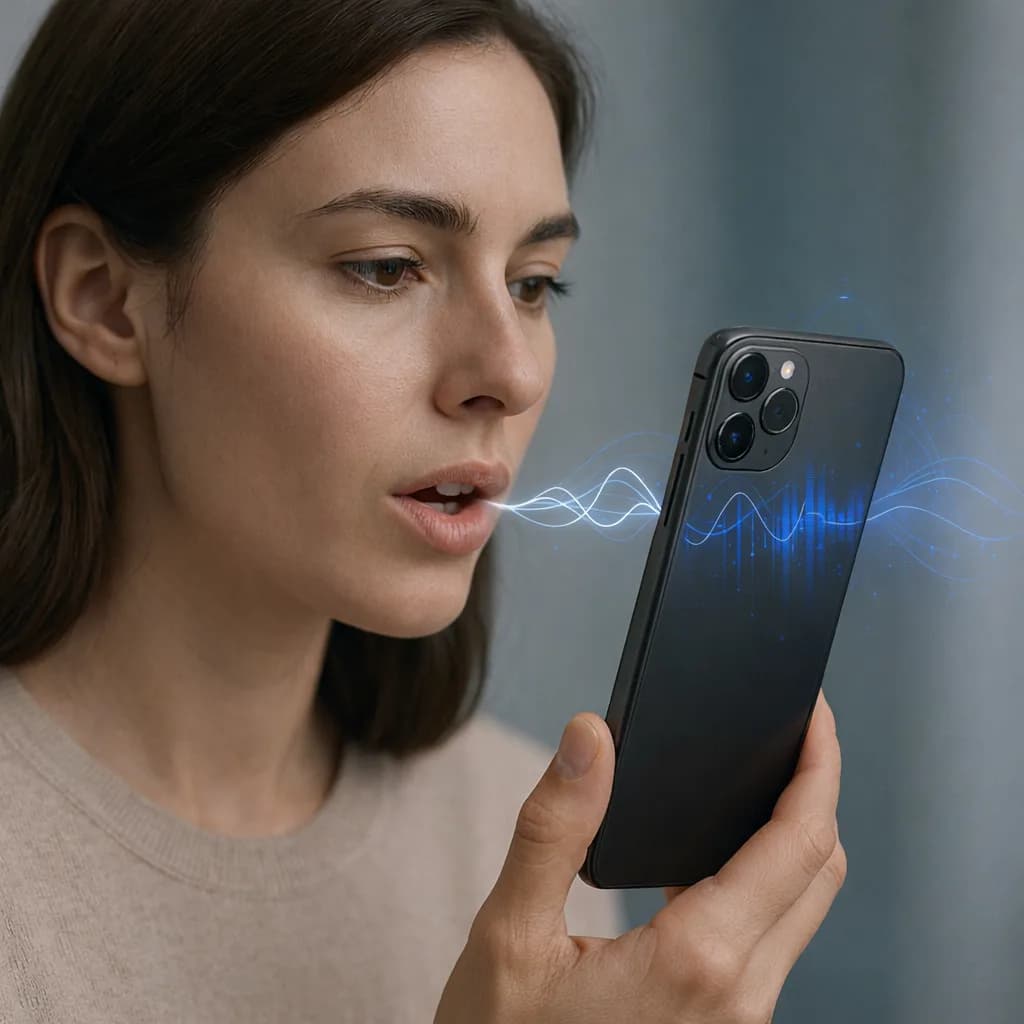
Speaking involves the brain, the lungs, the larynx and dozens of muscles. When something affects them, it can show in the voice: in its pitch, its rhythm, its pauses. Virtuosis AI, a spin-off of the Swiss Federal Institute of Technology in Lausanne (EPFL) founded by Lara Gervaise and Edoardo Giudice, turns those changes into health signals.
Since May 2025, MyTwin has piloted Virtuosis AI’s voice analysis in its private beta. About thirty seconds of speech are enough for the app to show signals associated with stress, anxiety and depressive mood. They are information to act on with a professional, not a diagnosis.
What a voice carries
Virtuosis AI analyses the acoustic characteristics of speech, not its meaning: pitch, pace, voice quality and rhythm. According to Lara Gervaise, more than 400 such parameters are extracted several times per second from a recording of about 30 to 40 seconds.
- Pitch, and how it varies
- Pace and pauses
- Voice quality
- Rhythm
Its models were trained on recordings collected in hospital clinical studies, each matched with a full medical assessment that includes confounding factors such as smoking or respiratory conditions, she explains on MyTwin Inside.
What it looks like in MyTwin
In the MyTwin pilot, the user records a short voice sample. After processing, which can take a few minutes, the app shows a level for stress, anxiety and depressive mood: low, moderate or high.
A result is a signal to watch, not a verdict. Lara Gervaise gives a concrete example: a recording made while very tired produces more false positives for depression, so the right reflex is to test again another day. Virtuosis AI itself stresses that its results are designed to complement, not replace, professional judgment.
Voice analysis also sits alongside physical data in MyTwin’s work on athletes, as in our injury-risk prototype for racket sports.
What the evidence says
Voice biomarkers are a fast-moving and promising research field. A 2025 meta-analysis of 105 studies on detecting depression from speech concluded that the approach shows promise, but should be regarded as a complementary method rather than a standalone clinical tool. An earlier systematic review of 127 studies on psychiatric disorders came to a similar view: speech analysis could aid mental health assessments, with many obstacles still to overcome.
Virtuosis AI publishes its own performance figures. For depression, measured against the PHQ-9 questionnaire, the company reports a sensitivity of 77% and a specificity of 83% on 1,933 people. These results have been presented as conference abstracts and posters; they have not yet been published as peer-reviewed articles.
Frequently asked questions
Does Virtuosis AI listen to what I say?
No. The analysis looks at how you speak, such as pitch, pace, rhythm and voice quality, not at the meaning of your words.
Can it diagnose depression?
No. It gives signals associated with stress, anxiety or depressive mood. A diagnosis can only come from a health professional, who takes other information into account.
Sources
Sources · 5
- 01Virtuosis AI, “About us”.
- 02Virtuosis AI, “What are voice biomarkers?”.
- 03Virtuosis AI, “Clinical validation”.
- 04Maran P.L. et al., 2025, “Performance of automatic speech analysis in detecting depression: systematic review and meta-analysis”, JMIR Mental Health.
- 05Low D.M., Bentley K.H., Ghosh S.S., 2020, “Automated assessment of psychiatric disorders using speech: a systematic review”, Laryngoscope Investigative Otolaryngology.
This news is provided for information only. The technologies it describes are at research or pilot stage, and none of them replaces advice, diagnosis or treatment from a healthcare professional.