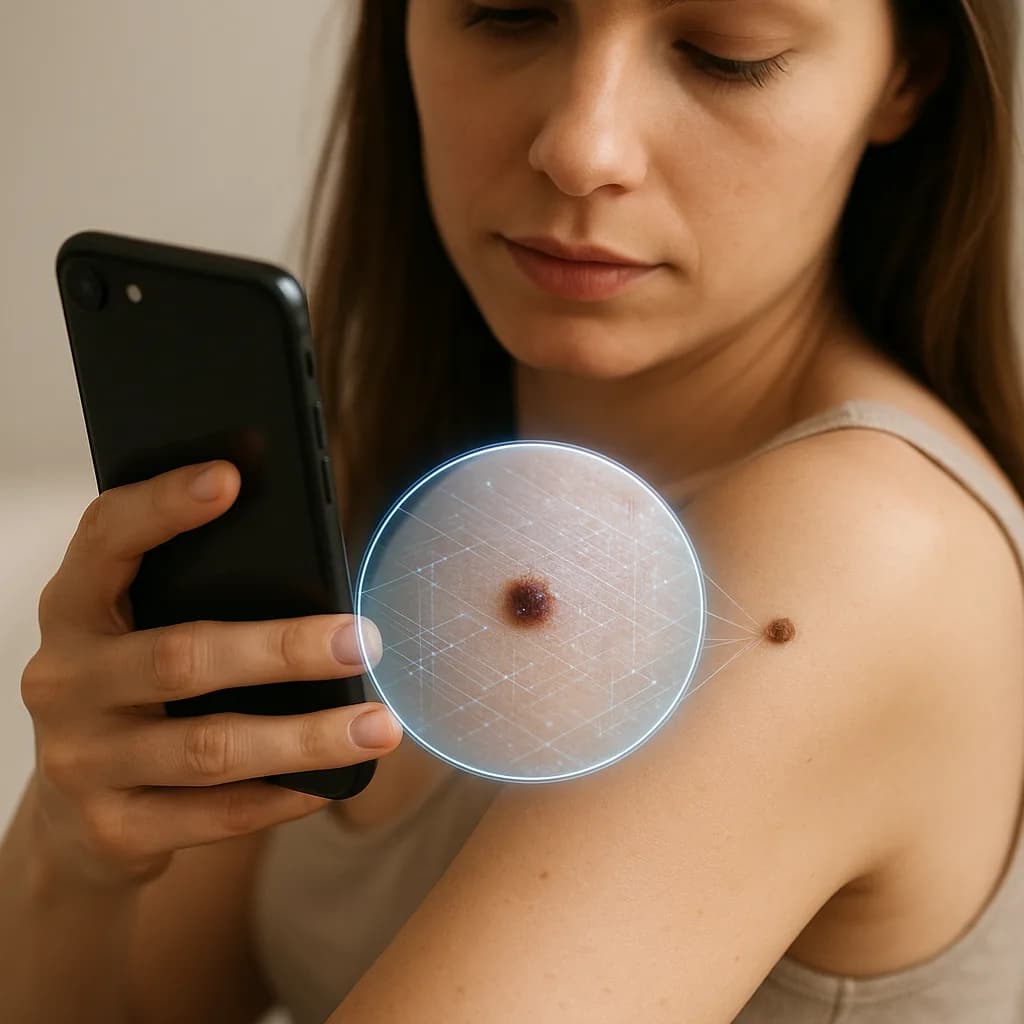
Cindy noticed a mole changing. The dermatologists she called had nothing available for five months. Her story, told on mytwin.care, is a common one: a legitimate worry, and a long wait for a first look.
Since May 2025, MyTwin has piloted Skinive in its private beta. The user photographs a skin concern; the app shows the probable types of lesion and the risk associated with them, and offers simplified access to a dermatologist, who confirms or rules out a diagnosis. The app itself makes none.
Why a first look matters
Skin cancers are among the most common cancers. In 2020, more than 1.5 million cases were diagnosed worldwide, and more than 120,000 deaths were associated with them, according to the World Health Organization. For melanoma alone, the International Agency for Research on Cancer projects about 510,000 new cases and 96,000 deaths a year by 2040, increases of roughly 50% and 68% on 2020.
Examining a lesion that changes is a dermatologist’s job. The question is what happens while a patient waits for one.
How Skinive works in MyTwin
- The user takes a photo of the area of skin that worries them.
- Skinive’s AI, which covers more than 55 skin conditions according to the company, returns the probable types of lesion and the risk associated with them.
- From the result, MyTwin offers simplified access to a dermatologist.
- The dermatologist examines the lesion, and confirms or rules out a diagnosis.
- 1YouTake a photoOf the area of skin that worries you.
- 2Skinive’s AIProbable lesion typesAnd the risk associated with them.
- 3MyTwinSimplified accessTo a dermatologist, from the result.
- 4DermatologistDiagnosisConfirmed or ruled out by the doctor.
Skinive is explicit about its role: its app “is not a diagnostic tool and is not intended to replace consultation with healthcare professionals”. The company states that it is a class I medical device under the European Medical Device Regulation, a class for which the manufacturer declares conformity itself.
The limits we keep in mind
AI skin-check apps have been studied closely, and the findings call for humility. A systematic review in The BMJ concluded that algorithm-based smartphone apps cannot be relied on to detect all cases of melanoma or other skin cancers. And the image datasets such tools learn from under-represent darker skin: in a review of public skin cancer image datasets, skin type was recorded for only 2.1% of the images.
Skinive’s published accuracy figures come from the company itself; we have not found an independent evaluation yet. That is why, in MyTwin, the photo leads to a dermatologist, not to a conclusion.
Frequently asked questions
Does Skinive tell me whether I have skin cancer?
No. It gives the probable types of lesion and an associated risk, to help decide when to see a dermatologist. Only a dermatologist can make a diagnosis.
What if the risk looks low but the lesion keeps changing?
See a doctor anyway. A lesion that changes deserves a medical examination, whatever an app says.
Sources
Sources · 6
- 01World Health Organization, 2022, “Ultraviolet radiation” fact sheet.
- 02International Agency for Research on Cancer, 2022, “Global burden of cutaneous melanoma in 2020 and projections to 2040”.
- 03Skinive, “Terms of use”.
- 04Freeman K. et al., 2020, “Algorithm based smartphone apps to assess risk of skin cancer in adults: systematic review of diagnostic accuracy studies”, The BMJ.
- 05Wen D. et al., 2022, “Characteristics of publicly available skin cancer image datasets: a systematic review”, The Lancet Digital Health.
- 06Sokolov K., Shpudeiko V., 2022, “Dynamics of the neural network accuracy in the context of modernization of the algorithms of skin pathology recognition”, Indian Journal of Dermatology.
This news is provided for information only. The technologies it describes are at research or pilot stage, and none of them replaces advice, diagnosis or treatment from a healthcare professional.