Contents
As part of the development of MyTwin Lab, a new step has been taken in building the patient’s digital twin: the creation of a full-body 3D avatar from a photogrammetric capture.
For this experiment, Rubens Valcy went to the Paris studios of Scan Engine to have his whole body digitised in 3D.
Scan Engine specialises in creating digital humans and realistic 3D avatars. Its system relies on photogrammetry: a large number of cameras are placed all around the subject and fire simultaneously, capturing the body from many angles. The studio says it uses a 360° setup with 192 high-resolution cameras, able to capture the subject in a fraction of a second.
Creating the patient’s external representation
From all the photographs captured at the same instant, the data are processed to generate a three-dimensional representation of the body.
The result is a digital avatar that reproduces the subject’s external morphology: body proportions, volumes, posture and the overall geometry of the body.
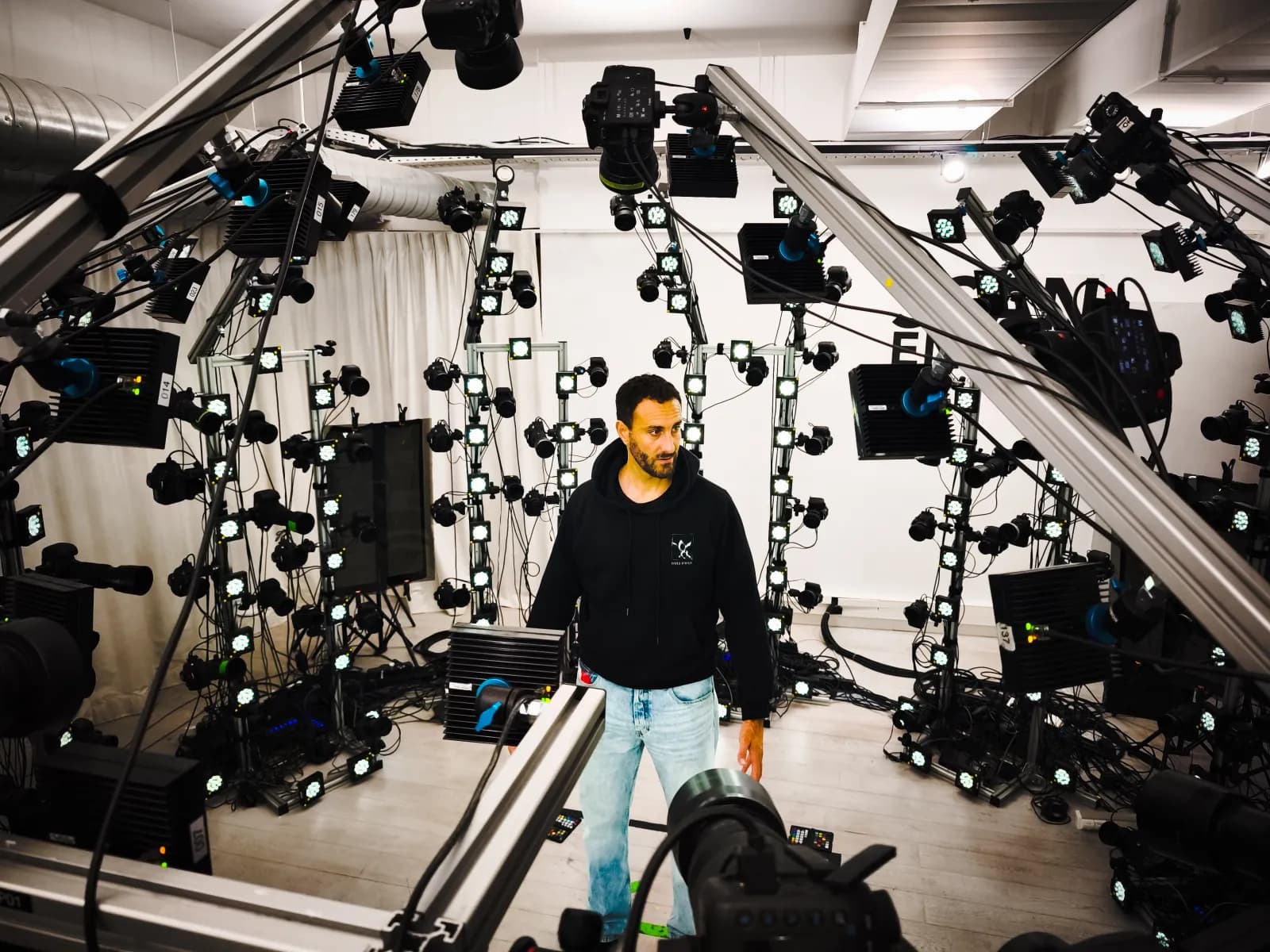 The capture
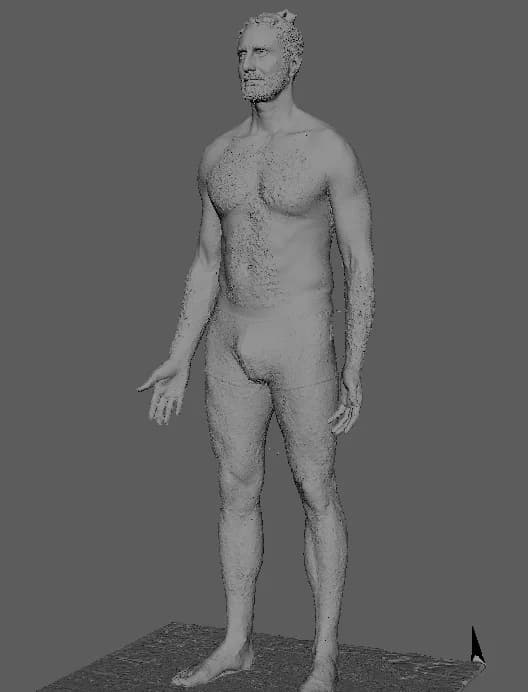 The avatar
This technology is already widely used in fields such as film, visual effects, video games and the creation of digital doubles. Scan Engine works on body and face scanning, and on producing realistic digital humans.
At MyTwin Lab, the interest is different: gradually integrating this external representation into a much broader representation of the patient.
From the visible body to the invisible body
A health digital twin can’t be limited to a single representation.
On one side, photogrammetry captures the patient’s outer envelope.
On the other, medical imaging is gradually making it possible to reconstruct what lies inside the body: organs, anatomical structures or specific areas of interest.
Other dimensions can then be added to these representations: biological and physiological data, medical history and biomarkers.
The goal is to gradually bring several levels of representation together:
- This stepThe outer bodyProportions, volumes, posture, overall shape.
- Medical imagingInternal anatomyOrgans, anatomical structures, areas of interest.
- BiologyBiological dataBiological and physiological data, medical history, biomarkers.
- Follow-upEvolution over timeHow all of it changes, alongside the real patient.
It is the path described in MyTwin Lab’s research vision, from the body down to the molecule.
Towards an ever more complete digital patient
This 3D scan is not, on its own, a medical digital twin.
It is, however, a new layer of data that helps build, step by step, a more complete digital representation of the patient.
In the long run, MyTwin Lab’s challenge is precisely to connect these different dimensions in a single environment, to create a model able to evolve alongside the real patient.
The logic is simple: the more relevant and complementary data a digital twin brings together about the same individual, the more representative of their real situation it can become. What a patient digital twin is, and what it is for, is explained in MyTwin’s guide to the patient digital twin.
And tomorrow, the goal will no longer be only to visualise a digital patient, but gradually to analyse how they change, compare different scenarios and simulate some possible futures.
This first full-body 3D avatar is a new step in MyTwin Lab’s ambition: building an ever more complete digital twin of the patient, from the visible body to the data that describe how it works inside.
Frequently asked questions
Is this 3D avatar a medical digital twin?
Not on its own. It reproduces the outer shape of the body, not what happens inside it. It is one layer of the digital twin, which still has to be connected to medical imaging, biological data and their evolution over time.
Can I get a full-body 3D scan through MyTwin?
Not today. This was an internal experiment by the MyTwin Lab team, and no 3D scan is offered to MyTwin users.