Contents
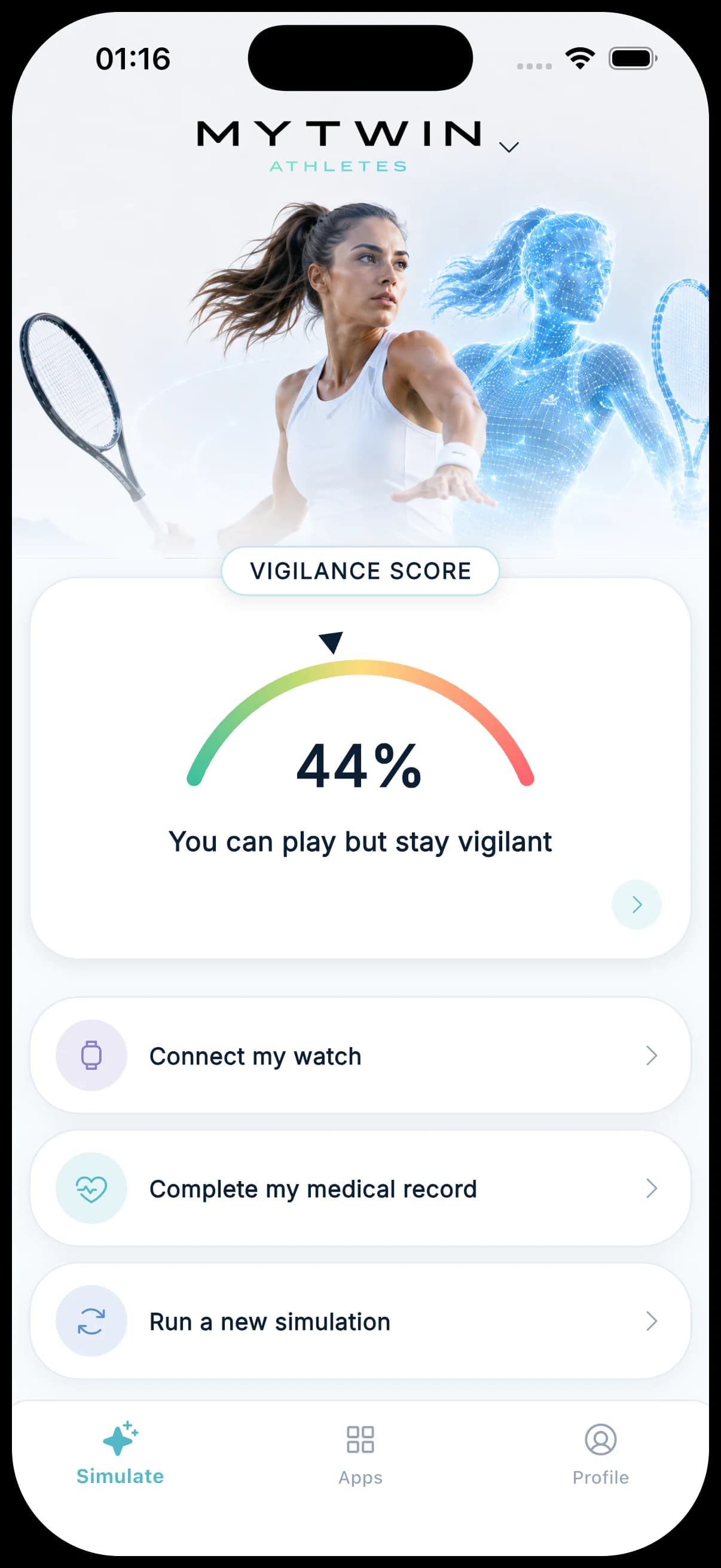
MyTwin Lab announces the launch of MyTwin Longevity, a new application of the MyTwin digital twin, in August 2026. It builds on the MyTwin Engine, the scoring engine prototyped in June 2026, and follows MyTwin Athlete as the second app built on the twin.
The objective: help people add years in good health, not only years. Starting from a blood check-up, the app estimates a biological age, maps the main organ systems and projects how risks may evolve. A doctor specialised in prevention and longevity then reads the results with the person and turns them into a plan.
Years in good health, not only years
According to the World Health Organization, global life expectancy was 71.4 years in 2021, and healthy life expectancy 61.9 years: close to ten years lived, on average, in less than full health. That gap is what longevity medicine works on, and what MyTwin Longevity is designed for.
The idea is to look early, while there is still room to act: measure where the body stands today, see which levers matter most for this person, and follow how things change over time. Our article on healthspan sorts what science really knows about living longer in good health.
A four-step journey
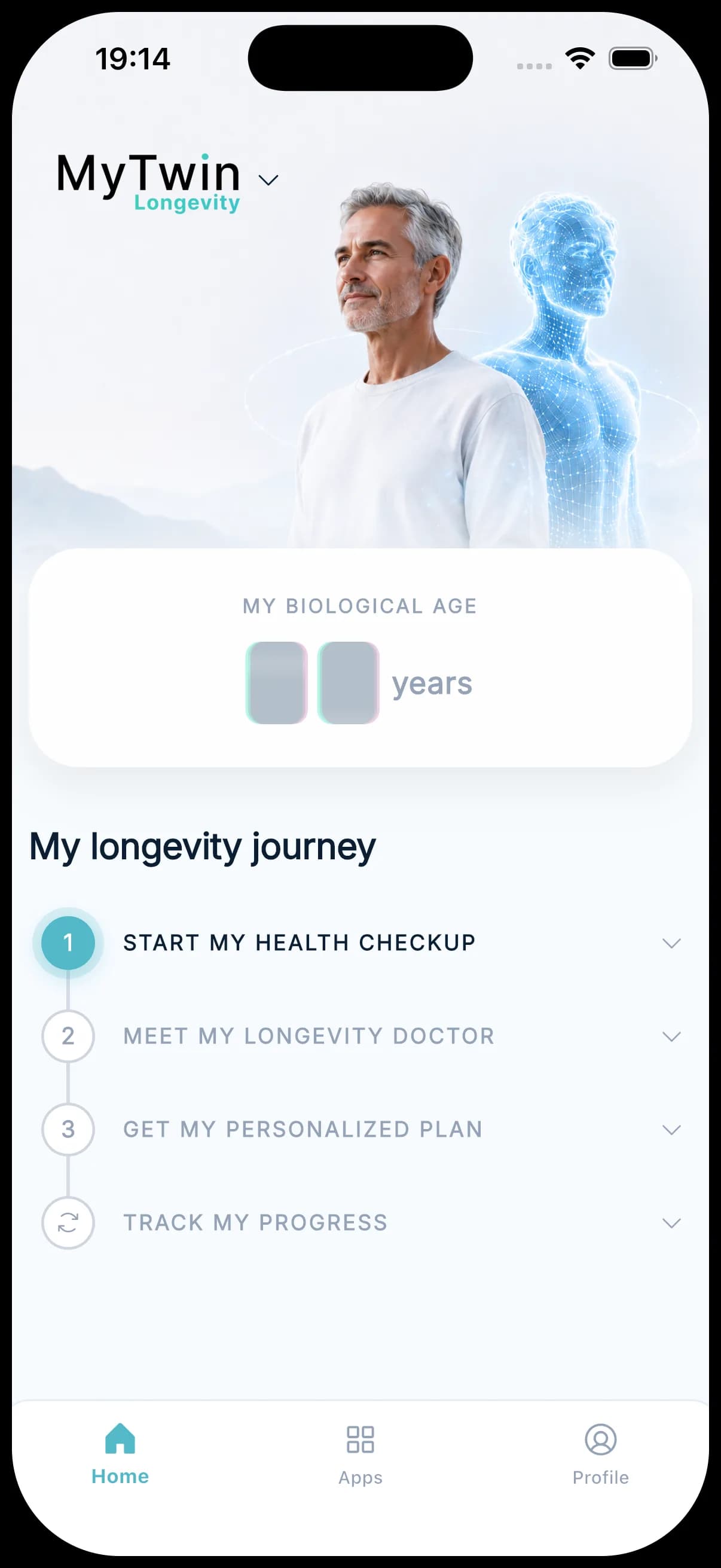
The app lays the journey out in four steps. It starts with a health check-up: the blood biomarkers feed the twin, and the biological age appears once the check-up is done. Our article on the preventive health check-up explains what such a check-up covers.
- Step 1Start my health check-upA blood check-up feeds the twin; biological age appears once it is done.
- Step 2Meet my longevity doctorAt least 30 minutes with a doctor specialised in prevention and longevity.
- Step 3Get my personalised planA plan built from the results and the consultation.
- ThenTrack my progressNew tests update the twin, and the journey starts again.
The second step is a consultation of at least 30 minutes with a doctor specialised in prevention and longevity, from MyTwin’s network of partner doctors. The results are not left for the person to interpret alone: they are read with a doctor, who helps build the personal plan of the third step. New tests then update the twin, and the journey starts again.
Biological age, from a routine blood test
MyTwin Longevity computes biological age with Phenotypic Age, or PhenoAge, a measure published in 2018. It combines chronological age with nine biomarkers found in a routine blood test, among them albumin, glucose, creatinine and C-reactive protein. In the original study, each additional year of Phenotypic Age was associated with a 9% higher risk of death, independently of chronological age, including among people who reported no disease.
A biological age is a signal, not a diagnosis. A single measurement is a snapshot; its value grows with repeated tests, which turn one number into a trajectory. That is why the journey loops back. Our article on biological age explains what the tests really measure, and what they don’t.
Beyond one number
Biological age is the entry point. Around it, the app brings three more views from the MyTwin Engine:
- Organ-system scores for the main systems of the body, such as cardiovascular, respiratory and musculoskeletal health.
- Risk projections: how a risk may evolve over the coming years, using validated models wherever they exist, such as QFracture for fracture risk.
- What-if simulations: what would change under a concrete decision, such as losing weight or changing one’s lifestyle, projected from the effects measured in published trials.
Each score carries the reliability level the engine gives it, from a clinically validated model to a composite index of our own. Not every domain has a score yet: more will be added as the data and the evidence allow.
Frequently asked questions
Does MyTwin Longevity replace my doctor?
No. The app estimates and projects; it does not diagnose. Its results are read during a consultation with a doctor specialised in prevention and longevity, and they don't replace your own doctor's follow-up.
When does my biological age appear?
Once the first step, the health check-up, is done: biological age is computed from blood biomarkers with PhenoAge. Before that, the app shows where it will appear.
Who are the longevity doctors?
Doctors specialised in prevention and longevity, from MyTwin's network of partner doctors. The consultation lasts at least 30 minutes.
Sources
Sources · 3
- 01World Health Organization, COVID-19 eliminated a decade of progress in global level of life expectancy, 2024
- 02Liu Z. et al., A new aging measure captures morbidity and mortality risk across diverse subpopulations from NHANES IV, PLOS Medicine, 2018
- 03Hippisley-Cox J., Coupland C., Derivation and validation of updated QFracture algorithm to predict risk of osteoporotic fracture in primary care in the United Kingdom, BMJ, 2012
This news is provided for information only. The technologies it describes are at research or pilot stage, and none of them replaces advice, diagnosis or treatment from a healthcare professional.