Contents
When a physiotherapy session ends, much of the work moves home: exercises repeated between visits, alone, with nobody to check the movement or count the repetitions. The physiotherapist, in the words of the project, “has no way to know what actually happened”.
MyKine, proposed by Alix Chagot in the MyTwin Lab Sandbox in September 2026, starts from a simple observation: a phone camera is the one sensor every patient already has. MyKine uses it to count repetitions and measure joint angles during each exercise, and not a single image leaves the device. It is an early project, a web demo, and it is looking for the community’s support to go further.
The weak link between two sessions
Home exercise programmes are a pillar of physiotherapy, and following them is hard. A systematic review found that non-adherence to home-based physical therapy can reach 70%, with self-efficacy, motivation and social support among its predictors.
Adherence is also poorly measured. In a systematic review of 176 trials on knee osteoarthritis, only 40.9% reported exercise adherence at all. Without a measurement, a physiotherapist adjusting a programme works from what the patient remembers. Following patients between visits with real-world data is exactly the question our article on real-world data in patient monitoring explores.
The need is anything but marginal. About 1.71 billion people live with a musculoskeletal condition, the leading contributor to disability worldwide, and an estimated 2.4 billion people could benefit from rehabilitation, according to the World Health Organization.
How MyKine measures a session
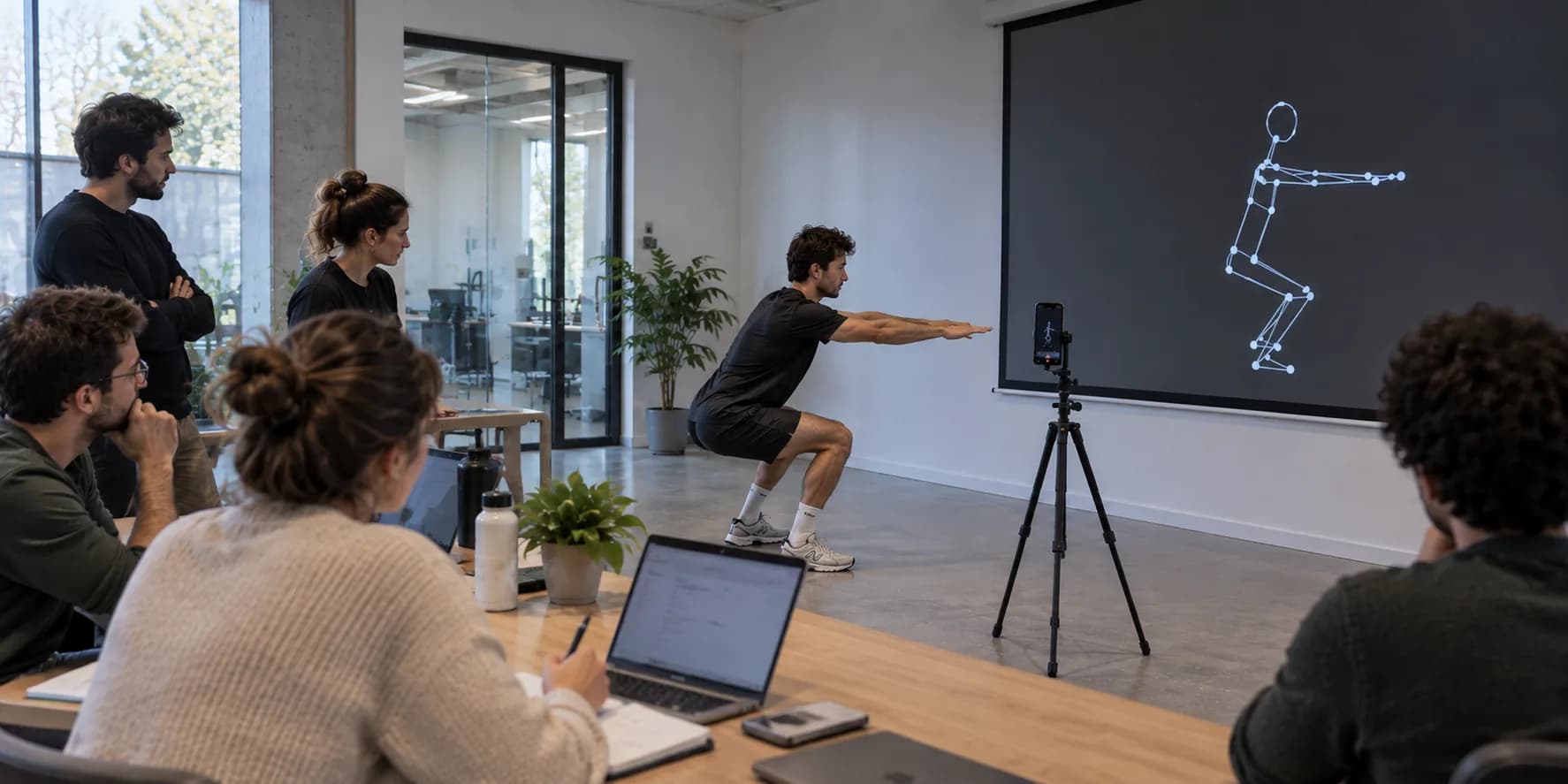
The patient opens the session of the day, from the programme their physiotherapist prescribed, and sets the phone down facing them. During each exercise:
- a pose-estimation model, Google’s MediaPipe Pose Landmarker, tracks body landmarks in real time, on the device;
- a scoring layer turns those landmarks into joint angles and repetitions, with explicit angle thresholds for each exercise rather than a black-box model;
- at the end comes a summary of the session, and a skeleton replay of each set: the landmarks are kept, never the video.
- 1Camera · The phone films the exercise.
- 2Pose model · Body landmarks, tracked on the phone.
- 3Angles and reps · Explicit thresholds per exercise.
- 4Session summary · Plus a skeleton replay of each set.
Leaves the phone: no image, no video.
The exercise library is designed so that a physiotherapist can extend it without touching the code.
What it deliberately doesn’t do
MyKine shows measurements. It does not tell the patient how to correct a movement, and it does not change their programme. That line matters: under European guidance, software that recommends personalised rehabilitation exercises for a musculoskeletal condition qualifies as a medical device. Measuring stays on one side of that line; prescribing is the physiotherapist’s job.
The measurement itself has limits, and the project doesn’t hide them. Markerless motion capture is progressing fast, but a review of the field found that its joint angles are not yet accurate enough for clinical applications, and another that its use in clinical measurement is still at a preliminary stage. MyKine’s angle thresholds have not yet been reviewed by a physiotherapist or checked against real recordings.
From a Sandbox project to a challenge
In the Sandbox, a project is carried by its author, and the community stars the projects it wants built. The most supported ones can be promoted into official MyTwin Lab challenges, where other contributors can join the work.
For MyKine, the next steps are the ones a demo can’t skip: a review of the exercises and thresholds by physiotherapists, and tests on real sessions. Each of them will be told here.
Frequently asked questions
Can patients use MyKine today?
Not yet. MyKine is a web demo proposed in the MyTwin Lab Sandbox. It is not a medical device and does not replace a physiotherapist.
Does MyKine record video?
No. The camera image is processed on the device to find the body landmarks. Only those landmarks are kept, for the session summary and the skeleton replay.
I'm a physiotherapist. How can I help?
Star the project in the Sandbox to show it is worth building. Once promoted into a challenge, it opens to contributors, and a physiotherapist's review of the exercises and thresholds is exactly what it needs.
Sources
Sources · 8
- 01Essery R. et al., 2017, “Predictors of adherence to home-based physical therapies: a systematic review”, Disability and Rehabilitation.
- 02Smith K.M. et al., 2023, “What are the unsupervised exercise adherence rates in clinical trials for knee osteoarthritis? A systematic review”, Brazilian Journal of Physical Therapy.
- 03World Health Organization, 2022, “Musculoskeletal health” fact sheet.
- 04World Health Organization, 2024, “Rehabilitation” fact sheet.
- 05Google AI Edge, “MediaPipe Pose Landmarker” documentation.
- 06Medical Device Coordination Group, MDCG 2019-11 rev.1, 2025, “Qualification and classification of software”, European Commission.
- 07Wade L. et al., 2022, “Applications and limitations of current markerless motion capture methods for clinical gait biomechanics”, PeerJ.
- 08Lam W.W.T. et al., 2023, “A systematic review of the applications of markerless motion capture technology for clinical measurement in rehabilitation”, Journal of NeuroEngineering and Rehabilitation.
This news is provided for information only. The technologies it describes are at research or pilot stage, and none of them replaces advice, diagnosis or treatment from a healthcare professional.